The operating models we inherit
The way a business is built shapes the work it must do—and the choices its leaders may mistake for necessities.
- By
- Cam Myers
- Content type
- Point of View
- Reading time
- 10 min read
- Status
- Author’s perspective
- Topics
- Operating Models
In brief
- The difficult judgment is deciding when to improve the work and when to change the conditions that require it.
- A dependency removed is a dependency exchanged.
- The business has reduced work only if the combined burden falls for the result it needs.
Start with the outcome
You can spend months improving a process that a different system design would make unnecessary. The difficult judgment is deciding when to improve the work and when to change the conditions that require it.
Every business is a system of connected elements: people, assets, information, and technology. It contains smaller systems and operates within larger ones. Their relationships create dependencies and constraints that shape how work happens. Some conditions come from the external environment. Others follow from choices the business has made, sometimes so long ago that nobody treats them as choices anymore.
Let me use a simple metaphor to make that distinction concrete. Starting from first principles, separate the outcome the business needs to achieve from the mechanism it uses to achieve it.
One outcome. Two ways to deliver it.
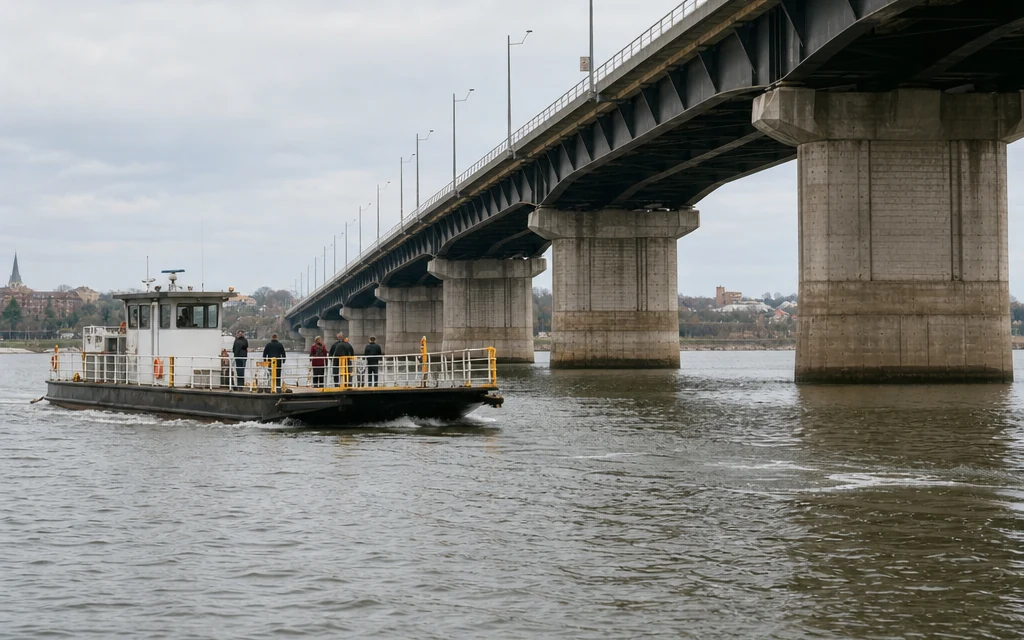
The diesel ferry
Imagine a business that gets people across a river safely and profitably. Its chosen mechanism is a diesel ferry. The vessel, docks, crew, fuel supply, and ticketing arrangements form an operating architecture. That architecture creates process problems: how much fuel to procure, when to schedule maintenance, and how to board passengers efficiently.
Those are legitimate opportunities for improvement. But what if another mechanism could serve the same commercial purpose more efficiently?
The toll bridge
A toll bridge could also get people across and collect revenue. Fuel procurement and vessel maintenance would cease to be operating requirements. Construction, inspection, financing, and toll collection would take their place. The bridge would be preferable only if its service and investment economics justified the change. Eliminating ferry work would not establish that by itself.
What the comparison reveals
The distinction matters in digital transformation because AI can change both the mechanisms available and the cost of testing them. A process-improvement program may begin by treating the current architecture as fixed. An architectural inquiry asks which of its dependencies should remain fixed before committing resources to improving them.
The decision underneathWhich required outcome fails, or which unacceptable consequence occurs, if the proposed process change is deferred?
Find the dependency behind the process
In an auction engagement, the immediate requirement was suitable product classifications in advertising feeds. Internal inventory categories were assigned inconsistently and were often too broad to map reliably to the desired Google product categories. The discussion expanded toward taxonomy redesign, revised cataloging procedures, and potentially changes to team responsibilities.
The important diagnosis was that product titles and descriptions contained distinctions the internal categories did not preserve. Advertising classification had been made dependent on a less informative intermediate field.
For illustration, consider an interior door and a replacement window both assigned to a broad category called Building materials. A mapping rule receiving only that category sees the same input for two different products. Making the rule more elaborate cannot reliably recover a distinction absent from its input. The product descriptions may still contain it.
That leaves different architectural choices. The business could make internal categories sufficiently detailed for the advertising requirement. It could derive the advertising category independently from richer product information. The first choice makes the upstream representation serve another purpose; the second separates two classifications that need not be identical.
I built a narrowly scoped application that reads the existing product feed, uses AI to interpret titles and descriptions, and applies rules I developed to guide Google category assignments. A supplemental feed supplies the resulting classifications to the existing data flow. The build took approximately two hours because the information and feed mechanism were already available.
The intervention resolved the feed-category issue we were addressing without requiring catalogers to adopt a new procedure. It removed the proposed taxonomy overhaul as a prerequisite for that outcome. Classification continued through software, and any case for improving the internal taxonomy for inventory control or reporting remained separate.
This establishes a dependency removed and proposed operational work avoided. Advertising lift and net financial savings require their own measurement. The architectural result is that one downstream requirement no longer has to wait for a broader source-system initiative.
A dependency removed is a dependency exchanged
The alternative still relies on product descriptions containing enough information, the classification method interpreting it appropriately, and the supplemental data reaching the correct product record. The question is whether these dependencies are less burdensome to satisfy than the ones they replace.
Three forms of correctness need to be distinguished. A category can be valid in Google's taxonomy and still describe the wrong product. A correct classification can be attached to the wrong item. An accurate result can also arrive too late to serve the intended campaign. Checking the category code alone would miss the other failures.
Evaluating the alternative requires evidence at each of these points.
Scroll horizontally to view all columns.
| Dependency | Failure to detect | Evidence to seek |
|---|---|---|
| Product descriptions | Distinguishing facts are absent or ambiguous | Review sparse descriptions and mixed-product lots |
| Classification logic | Valid category code describes the wrong product | Compare assignments with reviewed reference categories |
| Feed integration | Correct category attached to the wrong or stale item | Check item identifiers and update timing |
| Operating ownership | Exceptions recreate manual workload | Measure review and correction effort and assign support |
Google's native classification is also an architectural option. Google already categorizes products automatically and permits submitted overrides for specified uses; supplemental sources provide a mechanism for enriching existing product data.[2][3] A custom layer should be assessed against that option, existing mappings, and source improvements. Its presence does not establish superior accuracy.
This distinction becomes important when AI replaces a human interpretation step. The task may leave the cataloger's workflow while review, correction, and support obligations appear elsewhere. The business has reduced work only if the combined burden falls for the result it needs.
Compare architectures on equivalent terms
The ferry metaphor begins with a shared purpose, but an investment comparison requires a more precise outcome. Capacity, waiting time, availability, and price may differ between ferry and bridge. If those differences change demand or revenue, comparing operating costs alone would be misleading.
The same discipline applies to software. First establish the required service and acceptable error consequences. Then compare credible designs over the same volume and time horizon. Include the transition as well as ongoing operation. Faster delivery has value, but so do dependable operation and a workable exit if the design fails.
For classification, one useful unit is the cost of a usable assignment: processing plus review, correction, and attributable support effort for an assignment that meets the defined requirement. Raw model cost and average accuracy describe only parts of that calculation.
Errors also differ in consequence. A neighboring category may leave a product in a commercially suitable group; a distant category may place it outside the intended campaign structure. An evaluation should reflect the decisions affected, rather than treating every category disagreement as an equal loss.
The result can favor a modest architecture. If existing rules or the platform's classifier already satisfy the requirement at lower total cost, an additional application may be unnecessary. If product descriptions omit essential facts, interpretation cannot substitute for observing and recording them. If exceptions consume most of the effort supposedly released, the operating advantage may disappear.
Conversely, a targeted interpretation layer can be valuable when it uses sufficient existing information, isolates a specific downstream need, and avoids imposing that need on an entire source operation. That was the design opportunity in the cataloging case: solve a bounded requirement without making a broader organizational change a condition of delivery.
Use cheaper experiments to change the sequence
AI affects architecture in two distinct ways. Models can make certain interpretations computationally practical. AI-assisted development can also reduce the effort needed to test a narrowly scoped alternative. The second change matters even when the eventual production system contains little AI.
When the uncertain mechanism becomes inexpensive to test, leadership can gather evidence before committing to a larger process initiative. A prototype can examine whether available descriptions support the required distinctions, where the method fails, and how much intervention those failures require. That evidence can change the scope of the operating project.
The experiment needs a decision attached to it. Define which result would justify proceeding and which would justify stopping or improving the source. Otherwise, cheap prototypes can accumulate applications and dependencies without resolving the original investment question.
This is a change in the timing of learning. It can be sensible to understand current work, test an alternative architecture, and only then decide which procedures need redesign. Systems engineering treats architecture, operating concepts, and derived requirements as interdependent and iterative.[1] A rigid instruction to perfect current processes first can foreclose the evidence needed to choose among designs.
Know when the process really is necessary
Understanding current work remains essential. Existing procedures may contain knowledge about exceptions, accountability, or facts that no system currently captures. A required approval represents a decision that still has to be made. A missing physical observation still has to be obtained. Technology does not remove these needs merely by changing the interface.
A broader source improvement can also be the better investment when many functions need the same distinction. Separate classifiers for every downstream use might create more maintenance and disagreement than a well-designed shared taxonomy. Independence is useful when it removes unnecessary coupling; consistency is useful when multiple functions genuinely require a common representation.
The management test is therefore specific: which required outcome fails, or which unacceptable consequence occurs, if the proposed process change is deferred? If another design can supply the needed function, the change may remain valuable without being a prerequisite. If it cannot, the process work has a defensible place in the sequence.
I would make that inquiry part of transformation decisions whenever a material change in capability, cost, or demand changes the alternatives. It does not require repeatedly reopening every settled design. It requires recognizing when the assumptions behind a dependency deserve another examination.
The task is to distinguish work inherent to the intended outcome from work contingent on the architecture. Then test whether a different arrangement improves the business after accounting for the obligations it introduces. That is the judgment that determines whether an inherited process should be improved, automated, or made unnecessary.
Sources
For the leadership team
In practice
- Compare credible designs over the same volume and time horizon, including transition and ongoing operation.
- Evaluate the cost of a usable assignment, including review, correction, and support.
- Define which experimental result justifies proceeding, stopping, or improving the source.
Questions worth asking
- Which required outcome depends on this process—and could another design supply the function?
- What new dependencies, failure modes, and support work would the alternative introduce?
- What evidence would justify the investment on equivalent service and cost terms?
Weighing this decision now? Tell us what you are considering and we will say plainly whether we can help.
Discuss your business Point of View6 min
The New Boundaries of the Firm
When coordination gets cheaper, reconsider where work belongs.
Read insight Point of View6 min
The Economics of Adaptability
Price the cost of changing the system—not just the cost of launching it.
Read insight Point of View6 min
When records diverge from reality
Dependable automation starts with facts the business can verify.
Read insight